ECCV 2026 · Malmö

Who, Where, and When in
Agentic Multi-Camera Person Search

ARGOS · Agentic Retrieval with Grounded Observational Search

Myungchul Kim1   Kwanyong Park2,†   Junmo Kim1,†   In So Kweon1,3,†

1 KAIST    2 University of Seoul    3 KIST

† Corresponding authors

Real witnesses do not hand over a clean query. They give fragments of who they saw, where, and when, scattered across cameras and time. ARGOS turns person search into an agent that asks, tests, and eliminates.

Abstract

Person search is normally posed as one-shot retrieval from a complete query, either a cropped image or a full text description, matched against a static gallery. Witness testimony rarely arrives in that form. It comes as fragments about who was seen, roughly where, and roughly when, often hedged and sometimes inconsistent.

We formulate interactive multi-camera person search, in which an agent recovers the target by questioning a witness over several turns while reasoning over the spatio-temporal structure of the camera network. To study the task we build ARGOS, a benchmark of 2,691 tasks across 14 scenarios in an industrial factory and a university campus, derived from 16 synchronized cameras and 1,273 annotated identities in MTMMC.

Each scenario is grounded in a Spatio-Temporal Topology Graph (STTG), a directed weighted graph whose nodes are cameras and whose edges carry measured transition-time statistics. Ground truth is computed from the STTG and the tracking annotations, and a language model is used only to phrase the witness's replies, so benchmark correctness never depends on LLM behavior.

We also release a tool-augmented agent baseline with four modules and eight tools. Across four LLM backbones the best agent reaches a Turn-Weighted Success of 0.383 on the spatial track and 0.590 on the temporal track, against an oracle score of 1.000. Ablations attribute most of that performance to the spatio-temporal tools: removing the temporal tool costs 49.6 points of Top-1 accuracy, and single-pass inference without interaction reaches 11.3%.
Motivation

The query is never complete

Person search research assumes the query arrives whole, the match happens once, and appearance carries all the information. Each of those assumptions breaks as soon as a real witness starts talking.

Prior formulations
ARGOS
✗
Complete query
A visual crop or a full text description, given upfront and assumed sufficient.
✗
One-shot matching
A single similarity search over a static gallery, with no second chance to ask.
✗
Appearance only
Even multi-modal ReID reasons purely about how the person looked.
→→→
✓
Partial clues
Fragments collected over dialogue turns, hedged and sometimes contradictory.
✓
Interactive reasoning
The agent plans, asks, and filters under uncertainty within a turn budget.
✓
Space and time
Camera topology and measured transit times rule candidates out.
New task

Interactive multi-camera person search

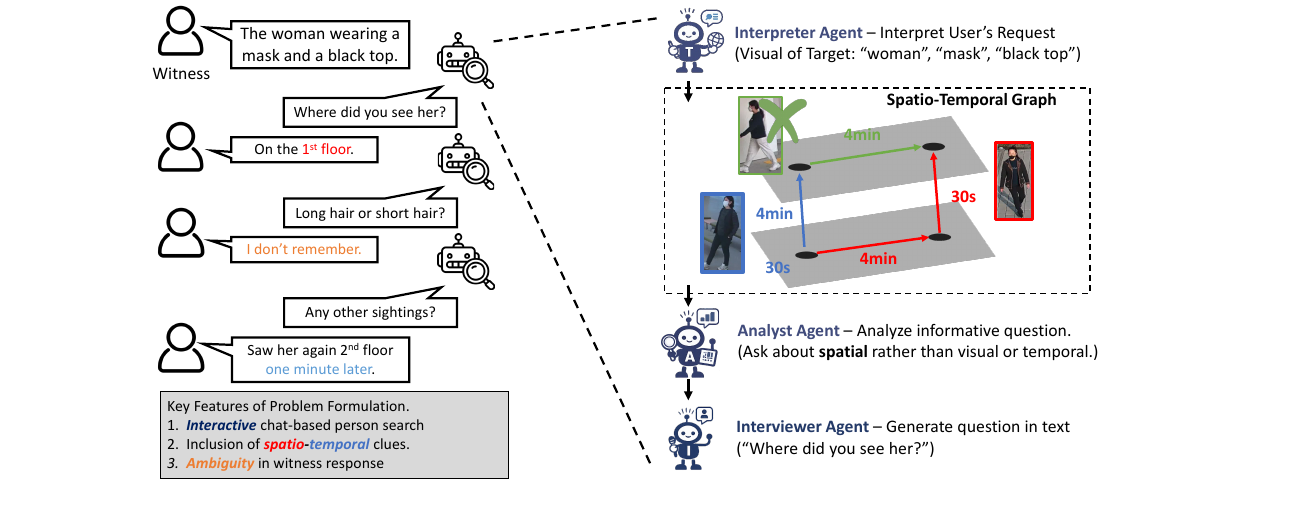
An episode opens with a vague witness statement. At each turn the agent picks one action: ask an attribute question, query the gallery, invoke a spatial or temporal tool against the topology graph, or commit to a prediction. It has to decide what to ask, when to spend a turn on a tool call, and how to read a hedged answer, all inside a 20-turn budget.

Overview of interactive multi-camera person search in ARGOS
Figure 1. Interactive multi-camera person search. Given only a vague witness statement, the ARGOS agent asks targeted questions and issues spatial and temporal tool calls over multiple turns to locate the target across a 16-camera network. Spatio-temporal filtering is long established in re-identification; what is new here is that the decision to use it belongs to the agent.
Walkthrough

Four episodes, replayed turn by turn

Each case below is a single benchmark episode run twice under identical conditions: the same witness, the same initial candidate set, the same turn budget. The only thing that changes between the two columns is the capability named in the tab. Step through the turns to watch the candidate set move.

Initial witness statement

Candidate trajectory

candidates left

candidates left

Grounding

Spatio-Temporal Topology Graph

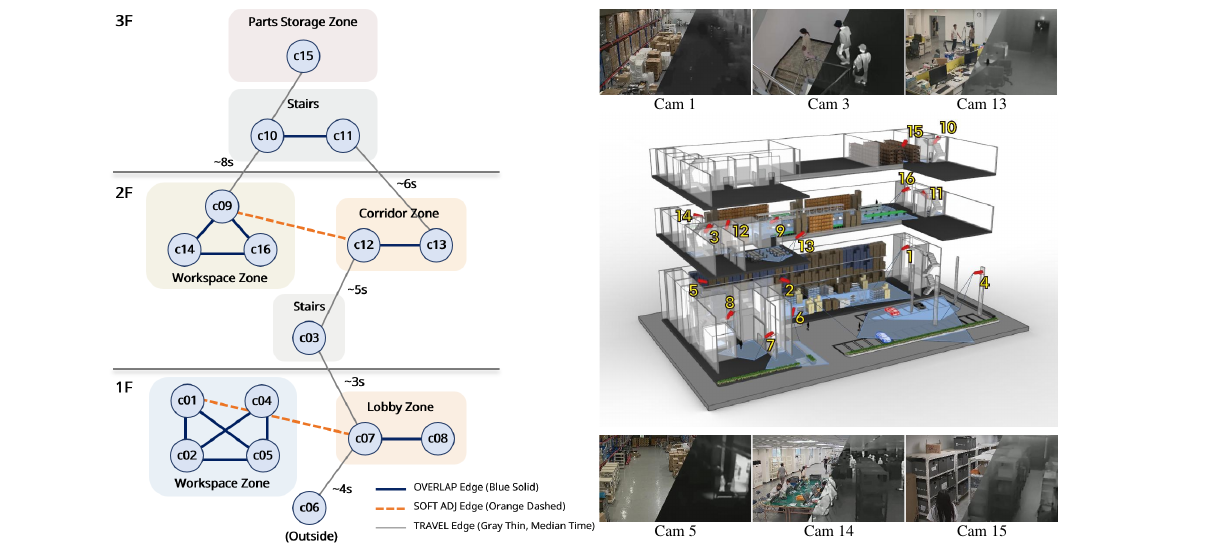
A directed weighted graph whose nodes are cameras and whose edges carry measured transition-time statistics. We build it from multi-camera tracking ground truth through transition extraction, priority-based edge labeling with human verification, and directed-edge aggregation, giving 110 edges for the factory and 149 for the university. The graph serves two roles: tasks are derived from it, and the agent queries it as a tool.

Spatio-Temporal Topology Graph for the factory scenario
Figure 2. Left: STTG for the factory (16 cameras). Nodes are grouped into zones by OVERLAP connectivity; edges are OVERLAP (blue), SOFT_ADJ (orange) and TRAVEL (gray), labeled with median transition time. Right: 3-D camera layout with sample RGB and thermal pairs.
Benchmark

2,691 tasks across three progressive tracks

All tasks draw from a common gallery of persons observed by 16 synchronized cameras in two environments, an industrial factory and a university campus, sourced from MTMMC. Track 1 isolates semantic parsing of the witness statement in a single turn; Tracks 2 and 3 add spatial and temporal reasoning on top of it.

2,691
Tasks
14
Scenarios
1,273
Annotated persons
16
Synchronized cameras
Track 1Who Track 2Where Track 3When
Task count9895501,152
InteractionSingle-turnMulti-turnMulti-turn
Core capabilitySemantic parsingSpatial reasoningTemporal reasoning
Avg. oracle turnsn/a2.021.89
Primary metricTop-1 AccTWSTWS

Table 1. Benchmark statistics. Track 1 is independently evaluable, while Tracks 2 and 3 presuppose its semantic parsing. Turn-Weighted Success (TWS) scores correctness weighted by turn efficiency relative to the oracle path, so a perfect agent scores 1.000.

Baseline

ARGOS Agent: four modules, eight tools

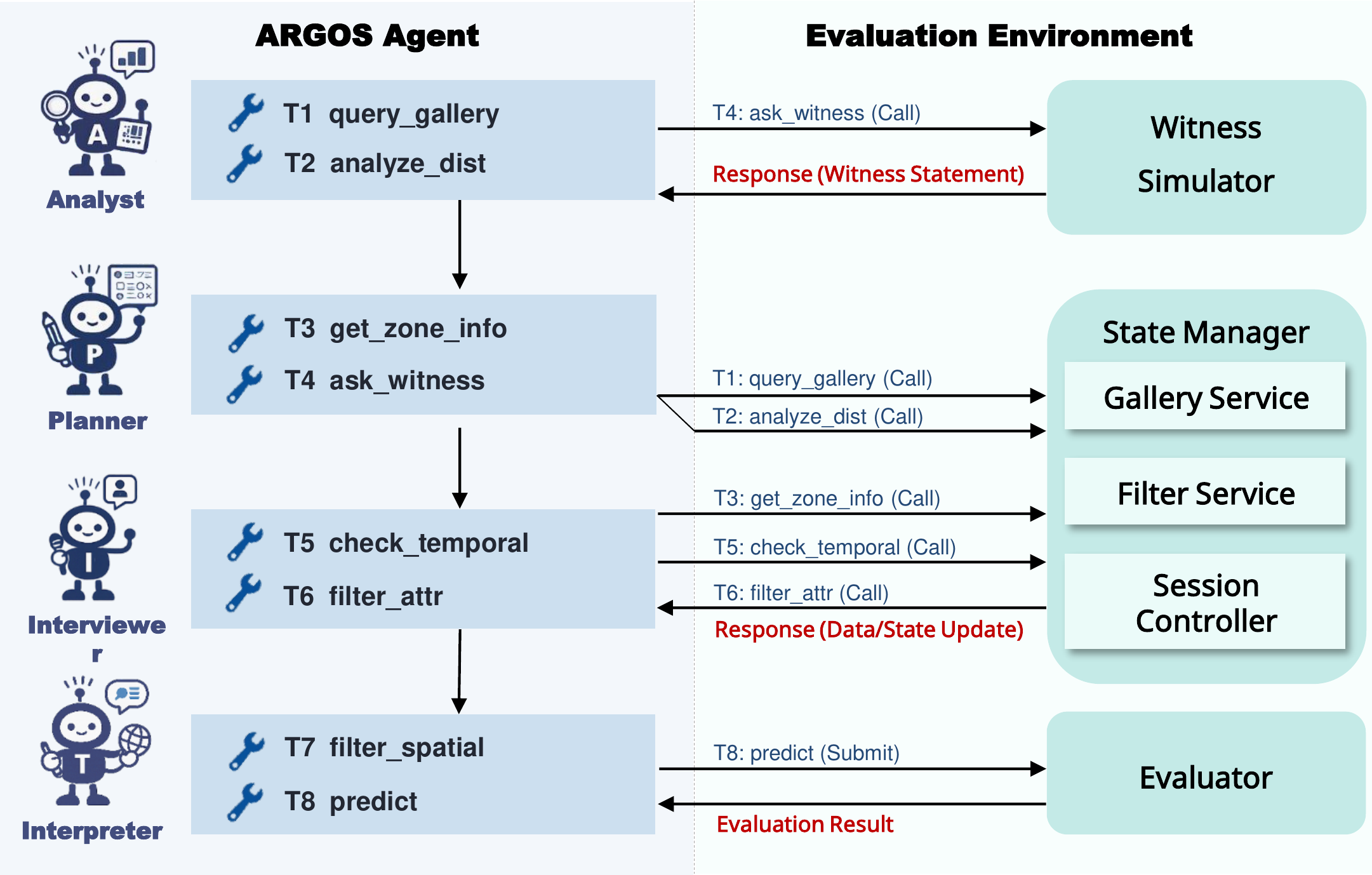
A tool-augmented LLM agent running an observe, think, act loop. The Analyst estimates how far each candidate action would narrow the candidate set, the Planner selects the next action, the Interviewer executes it, and the Interpreter converts the witness's reply back into a filter. The environment is deterministic, so failures trace to parsing, reasoning, or strategy rather than to noise.

ARGOS agent system architecture
Figure 3. System architecture. Left: the four LLM-driven modules and the eight tools they issue. Right: the evaluation environment, comprising a witness simulator, a deterministic state manager (gallery, filter, and session services), and an evaluator. The agent selects actions; the environment executes them and returns the resulting state.
Experiments

Far from solved

Four LLM backbones, a 20-turn budget, temperature 0. The best agent reaches TWS 0.383 on Track 2 and 0.590 on Track 3, both far below the oracle's 1.000, and no single backbone leads on both tracks.

Track 2 (Where, spatial) Track 3 (When, temporal)
Backbone TWSTop-1SR@5AvgT TWSTop-1SR@5AvgT
Oracle1.000100.0100.02.051.000100.0100.01.88
GPT-5.20.33873.133.67.040.59088.265.83.91
GPT-4o0.32374.531.67.490.56780.660.83.91
GPT-5-mini0.31974.932.27.480.55688.060.54.40
Claude Sonnet 40.38376.038.46.710.54883.659.54.25

Table 2. Main results on Track 2 (spatial) and Track 3 (temporal). SR@5 is success within a 5-turn budget; AvgT is the average number of turns on solved tasks. Best non-oracle TWS per track shown in teal.

Track 2 (Where) Track 3 (When)
AgentRemoved TWSTop-1 TWSTop-1
Oracleupper bound1.000100.01.000100.0
ARGOS Agentnone0.32374.50.56780.6
w/o Strategyreasoning0.13647.60.37376.9
w/o Spatialspatial tool0.06340.7n/an/a
w/o Temporaltemporal tooln/an/a0.05431.0
Single-Passinteractionn/a64.7n/a11.3
w/o All Toolsall toolsn/an/an/a11.4

Table 3. Ablation with GPT-4o as the backbone. Removing the temporal tool costs 49.6 points of Top-1 on Track 3, and removing the spatial tool costs 33.8 points on Track 2. With no tools at all, Track 3 collapses to 11.4%, which is the level of random guessing.

Grounding tools carry most of the signal
One feasibility query against the STTG narrows 19 candidates to 3. Physical reachability is a hard constraint, whereas attribute answers are frequently hedged or unknown.
The gain comes from the loop
Single-pass inference reaches 11.3% on Track 3 against 80.6% for the agent, and 11.4% with no tools at all. Interaction grounded in the STTG is what produces the difference.
Ground truth is computed, not generated
Answers are derived algorithmically from the STTG and the tracking annotations. A language model only phrases the witness's replies, so correctness never depends on LLM behavior.
The benchmark is far from saturated
Agents that do find the target still spend three to four times the oracle turn count, which is exactly what TWS penalizes. No backbone leads on both tracks.
Citation

BibTeX

@inproceedings{kim2026argos,
  title     = {ARGOS: Who, Where, and When in Agentic Multi-Camera Person Search},
  author    = {Kim, Myungchul and Park, Kwanyong and Kim, Junmo and Kweon, In So},
  booktitle = {European Conference on Computer Vision (ECCV)},
  year      = {2026}
}